

Pinot Noir through the ages
Joelle Thomson tastes her way through Pinot Noir history at a very special event in Martinborough...
Pinot Noir may be one of the oldest cultivated grapevines on Earth, but its history in this country spans less than half a century – a remarkably short time given its celebrated position today.
The first time anyone took any notice of Pinot Noir on a ‘significant’ scale in New Zealand was in 1989, when 138 hectares were counted nationwide. That made Pinot Noir the ninth most-planted grape back in those heady days when there was more Cabernet Sauvignon, more Chenin Blanc, more Gewürztraminer and nearly as much Palomino as there was Pinot. By contrast today, Pinot Noir is the second most-planted grape in New Zealand with 5,331 hectares (13%) – and counting – of the country’s total 42,520 hectares.
This brief history came into sharp focus at a retrospective tasting in Martinborough late last year where a full house of wine lovers paid to taste 34 years of Pinot Noir from acclaimed winery Ata Rangi.
“It was a courageous move to push the percentage of whole bunch fermentation up and it has remained so ever since.”
This was a private tasting co-hosted by Martinborough wine collector John Penney and Ata Rangi winemaker Helen Masters, who made all but two of the wines we tried. While the line-up spanned more than three decades, it didn’t include every single vintage, so we tasted wines from 1991, 2001, 2009, 2010, 2012, 2013, 2014, 2015, 2016 (one of my top scoring wines in this line-up), 2017, 2020 and 2021. “These are seriously important wines in terms of the history of the Wairarapa wine region because of how good these early wines were – and are,” said Helen.
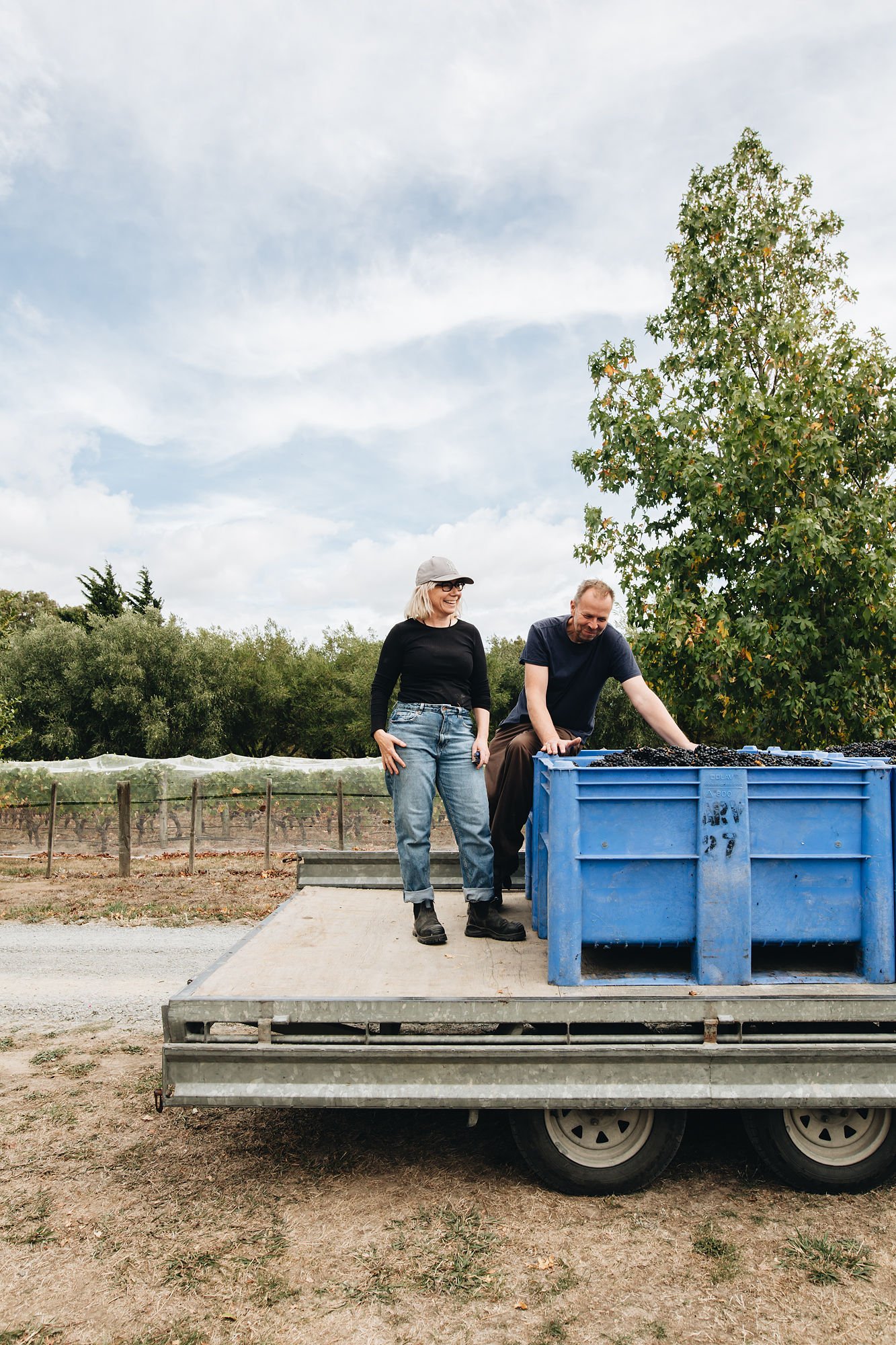
Ata Rangi head winemaker Helen Masters with viticulturist Ian Ewart.
The wines all stood up to the scrutiny of the roomful of winemakers, Pinot devotees and yours truly as the sole wine writer present. There was a Pinot Noir under cork that hadn’t fared particularly well but still had interesting aspects.
All the other wines had strong drinkability in their favour, which bodes well for the ageability of Kiwi Pinot Noir and one of Martinborough’s finest brands.
The consistent factor in all the wines was fruit appeal and a firm structure, which was amped up from 2017. Helen explained that prior to that it was typical to use a relatively low portion of whole bunches in a ferment, usually around 10%. But in 2017, Helen turned this on its head. “We knew it was a challenging year with cool weather, so I decided to increase the percentage of whole bunch fermentation to enhance the structure of the wine and see where that took us. The results were good and we have kept to that focus.”
The rest is history, in the making. It was a courageous move to push the percentage of whole bunch fermentation up and it has remained so ever since. In cool years this can run risks, which can be mitigated by stringent hand-picking, as at Ata Rangi and other quality-focused wineries in New Zealand, and this is one reason Pinot Noir has leapt ahead in quality. Others are vine age, winemaker understanding, and bravery to hold back young wines before release. The current vintage of Pinot Noir at Ata Rangi is 2022, which proves the point.
Further south in North Canterbury, Pegasus Bay winery holds back a portion of its Pinot Noir (and Riesling) every year to re-release as library wines 10 years later. These aged wines are typically excellent when released. Further south still, Central Otago winemakers are on a roll with their superb Pinots, which make up 80% of the region, but that’s another story.
Try this...
2021 Ata Rangi Pinot Noir
RRP $90
EuroVintage
A keeper from a warm, dry vintage characterised by small berries, rich concentration and wines of excellent structure. This wine has flavour layers of smoked red berries, dried mushrooms and a touch of spice, all promising longevity.

Joelle Thomson is a journalist, wine writer and author.